Mark Lea-Wilson is a mechanical engineer with an MBA that focused on economics, finance, and technology commercialization. He has 19 years of experience in the energy industry working in innovation, product development, manufacturing, and business management. His passion for energy and energy systems led him to recently earn a Certified Energy Manager certificate as well. He likes to connect information at system and sub-system levels, and understand how the small details affect the overall ecosystem, and vice versa. This helps formulate effective strategies and business systems.
The engineering and product design background of his early career also helped him understand physical systems at macro and microlevels. He values curiosity, discovery, collaboration, science, respect and integrity. His last role as Innovation Director and shareholder of a private manufacturing company involved blending the latest academic and business principles to identify and execute innovative business plans. It was a combination of formal training, project work, and networking that culminated in new product lines, partnerships, and an industry collaboration project aimed at commercializing innovations. It helped him understand the nuanced path that needs to be navigated to bring new ideas to light. Prior to that he was VP of Operations, overseeing manufacturing, engineering, supply chain, and assembly activities. Rooted in Lean manufacturing and process-thinking, the role taught him how a successful team needs to rely on each member.

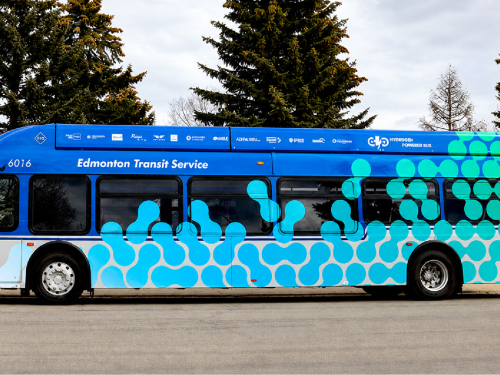
Patrick Baltazart is a senior engineer working with the city of Edmonton as corporate lead for Zero Emission Vehicle (ZEV) Transition.
He holds a master’s dual degree in industrial and electrical engineering and has developed several specializations, including project management, hydrogen technologies applied to vehicle refuelling and propulsion systems, large scale EV charging infrastructure, hazardous classification studies, electrical forensic analysis, power system analysis and simulation, power quality studies, energy storage, renewable energies, distributed energy resources, power generation (substations and power plants), transmission and distribution and district energy systems.
With over 25 years of experience across multiple environments (utility, oil & gas, transportation, industrial), Patrick worked for the City of Edmonton for 5 years after spending 20 years in the consulting industry. He is also an volunteer and active member of several Canadian Standard Association (CSA) committees.

Mahdi Shahbakhti is a Professor of Mechanical Engineering at the University of Alberta and an Adjunct Professor of Mechanical Engineering at Michigan Technological University. His research centers on modeling and control of dynamic systems including automotive systems, building energy systems, alternative and renewable energy systems.

Bahram Bahri is currently a researcher at the University of Alberta, specializing in advanced vehicle powertrains and alternative transportation technologies focused on reducing emissions and improving energy efficiency. His research expertise includes battery electric, fuel cell, diesel, and dual-fuel vehicle technologies, with a strong emphasis on sustainable and low-carbon transportation systems.
He has actively participated in the AZEHT, AZEFF, and AZETEC projects in Alberta, contributing to the testing, monitoring, and performance analysis of several heavy-duty vehicles, including diesel, battery electric, fuel cell, and dual-fuel buses and trucks operated under real-world Canadian conditions. His work involves operational performance evaluation, energy and fuel consumption analysis, drivetrain assessment, maintenance and reliability analysis, as well as Total Cost of Ownership (TCO) and Life Cycle Assessment (LCA) studies for transit and municipal fleets.
His research interests focus on vehicle decarbonization, alternative fuels, hydrogen technologies, and data-driven analysis for improving the efficiency, reliability, and operational performance of heavy-duty transportation systems in cold-weather environments.