Key Insights
- Powering Canada Strong reframes electricity policy as economic strategy. It’s a growth strategy powered by abundant, affordable, reliable, and clean electricity — not a clean electricity strategy that gestures at growth.
- The real prize is enabling electrification across transportation, buildings, and industry. The Transition Accelerator’s analysis for the Canada Electricity Advisory Council shows that with the right investments, Canadians could save $15 billion in total energy costs by 2050, with seven in ten households paying less than they do today.
- What’s new and significant: a serious push on electricity supply chains, the extension of the Clean Electricity ITC to intra-provincial transmission, a federal-provincial-territorial framework for interties, and a willingness to revisit the Clean Electricity Regulations to match the scale of the build.
- The call to revisit the Clean Electricity Regulations isn’t a pivot to natural gas, despite some of the headlines. It’s an opportunity to ensure the rest of the economy (transportation, buildings, industry) can pivot to clean electricity. The current regulations were modelled against roughly 50% electricity demand growth. The strategy commits to at least doubling. Any future amendments need to be calibrated around a clear objective: preserving affordability and reliability while enabling the electrification of the economy with a mostly clean grid.
- The strategy names the vision and the pillars. The hard work is implementation — working across jurisdictions, financing the build, and translating the pillars into action. Transition Accelerator, Electrifying Canada and our partners are ready to support this work. That’s where we go next.
A Strategy for Growth
The federal government released Powering Canada Strong this week. It’s a national electricity strategy that commits to doubling the grid by 2050 and puts electricity at the centre of Canada’s approach to economic growth, competitiveness, and energy security.
There’s a lot in the document that is aligned with views we heard at Electrifying Canada’s cross-country roundtables with utilities, provincial officials, academics and other electricity experts. What stood out to us:
- The framing of electrification as the real prize,
- The push on made-in-Canada electricity supply chains,
- The expansion of the Clean Electricity ITC to include intra-provincial transmission,
- The commitment to interties, and
- The willingness to revisit the Clean Electricity Regulations to match the scale of the build.
The strategy recognizes that the goal isn’t to make Canada’s already-clean grid a little bit cleaner. It’s to grow the grid so it can power Canada’s next economy, and to use that grid to enable electrification across transportation, buildings, and industry. This isn’t a clean electricity strategy that gestures at growth — it’s a growth strategy powered by abundant, affordable, and clean electricity.
The Prime Minister put it this way:
“In a rapidly changing and more volatile world, Canada is taking control of our future. With our new National Electricity Strategy, we will build at scale and speed to double our grid and power Canada strong with clean, affordable, reliable energy for all generations. When we master energy, we master our destiny.”
Enabling Electrification
The real prize is what happens when Canadian households and businesses electrify.
Electric machines — heat pumps, EVs, electrified industrial processes — are far more efficient than the fossil-fuelled equivalents, and that efficiency translates directly into money saved on energy bills. The Transition Accelerator’s analysis for the Canada Electricity Advisory Council, which the strategy itself draws on, found that with the right investments, Canadians could save about $15 billion in total energy costs by 2050, and seven in ten households would end up paying less on their energy bills than they do today. And the good news is that our analysis also identifies targeted supports that would allow disadvantaged communities to access these savings.
That matters even more in the current global moment. Energy prices have become a structural source of volatility for households and economies, shaped by wars, trade disruption, and supply shocks. Electrification, powered by Canadian electricity, is one of the few real hedges Canadian households and industry have against that volatility.
The strategy clearly recognizes this. The approach is fundamentally about building a grid that can enable electrification at the pace and scale Canada needs.
Electricity as Industrial Policy
The strategy’s most important shift is the recognition that Canada can’t keep being a passive consumer of the components and technologies that build a modern grid. With more than $1 trillion of buildout ahead over the next 25 years, the things that move electrons and the industries that run on them are an industrial opportunity, not a procurement line item. This is a new posture for the federal government, and it’s overdue.
The opportunity is clear throughout the system.
Upstream, Canada can build more grid technologies here at home. Transformers and switchgear are already among our faster-growing export categories. With targeted investment and the right policy signals, that capacity can scale to meet domestic demand and serve markets which are also anticipating significant grid growth. Downstream, low-cost clean electricity is a competitive asset for attracting the industries that will define the next economy: sovereign data centres, critical minerals processing, advanced manufacturing, and electrified industry.
This is territory the Transition Accelerator has been working in. Our trade diversification analysis sets out where Canada has competitive openings in the global clean economy and what it takes to capture them. We’re also in the middle of an analysis of Canada’s grid components value chain that will identify where domestic manufacturing capacity can be built and where there are critical gaps. We look forward to feeding both into the implementation of this strategy.
Big Transmission, In and Out of Provinces
In its most concrete move, the strategy designates interties as a project of national interest, spurring the design of a new federal-provincial-territorial framework with prioritization through the Major Projects Office. The Clean Electricity Investment Tax Credit will now be extended to major high-voltage intra-provincial transmission. Together, these moves finally match federal support to the transmission Canada actually needs to build — within provinces and between them.
Most transmission is intra-provincial, connecting new generation to load, reinforcing aging corridors, and getting power to new mines, factories, and data centres. Until now, the ITC didn’t cover this. Extending it is one of the cleanest levers the federal government has to back provincial buildouts without stepping on jurisdiction.
Interties are the next layer. The federal-provincial-territorial framework and MPO prioritization signal that interties are being treated as critical national infrastructure. We should finally move from the discussion on whether to build them to figuring out how.
The Transition Accelerator is working in both of those spaces. In Atlantic Canada, Electrifying Canada is supporting regional planning and infrastructure buildout to help meet the scale of regional economic ambitions. Also, through the Indigenous Power Coalition (IPC), we’re supporting a shift the buildout will require — moving from Indigenous Nations consultation to leadership on transmission, positioning Nations as proponents from project inception. Every new line in Canada’s doubled grid will cross Indigenous territories. And as IPC has argued, coalitions of Indigenous Nations can work across provincial borders in ways provincial governments often struggle to — making Indigenous leadership not just a question of rights, but the most practical path to getting interprovincial transmission built. This is exactly the kind of framework that can become part of the implementation pathway for the strategy.
The CER: Designed for a Different Grid
The commitment to amend the Clean Electricity Regulations (CER) is the most widely misunderstood aspect of the strategy. Some of the headlines have gotten the story backwards, framing this as a pivot to natural gas. It isn’t. It is what you do when the goal shifts from cleaning up the grid to doubling it to enable the rest of the economy to pivot to electricity. The debate is simpler than it appears, so let us explain.
To meet net-zero commitments, Canada must not only decarbonize electricity, but electrify households and industry. Focusing on decarbonizing electricity while ignoring the soaring demands of electrification risks missing the bigger picture. Canada’s grid is already more than 80% non-emitting and represents only 7% of national emissions. Transport, buildings, and industry account for multiples more. The prize isn’t a marginally cleaner grid. It’s an affordable, reliable and clean grid large enough to pull entire sectors off fossil fuels. The CER needs to be redesigned around that objective.
This is why the case for the amendments looks different when you start from the question the strategy is actually trying to answer: how do you build a grid twice as large that remains affordable, reliable, and overwhelmingly clean? The current regulations don’t answer that, as evidenced by their Regulatory Impact Analysis Statement, which modelled the regulation against a scenario of roughly 50% growth in electricity demand to 2050. The strategy now commits to doubling demand, at minimum. You shouldn’t regulate a system that needs 2x or 2.5x growth using a framework designed for one expecting only 1.5x growth. The regulation needs to be rebuilt around a clear objective: preserving affordability and reliability while enabling the electrification of the economy with a mostly clean grid.
So what does a regulatory framework built for that scale actually look like? Last year, Michael Liebreich made the case for what he calls the pragmatic climate reset: an argument that climate policy needs to focus less on restricting the old and more on building the new, and quickly enough that clean energy outgrows total demand and squeezes fossil fuels out of the system over time. Liebreich presented this case in Ottawa earlier this year.
That framework prompted us to apply the same arithmetic to the Canadian electricity sector. The model is simple — a few lines in a spreadsheet — but what it shows is clear: clean electricity only needs to grow modestly faster than demand for Canada to further build on its already strong position as a clean electricity leader.
Here’s the math. Doubling Canada’s grid by 2050 will require roughly 3% annual growth. If clean electricity grows even half a percentage point faster than this, the grid lands at about 90% clean generation in 2050 — cleaner than the 82% we have today. The share of emitting generation on the grid falls from 18% to around 10%, even as the absolute size of the grid doubles. And that bigger, cleaner grid is displacing fossil fuels across the rest of the economy: EVs replacing internal combustion engines, heat pumps replacing furnaces, industrial processes moving off gas and coal. Every new kilowatt-hour does double duty — cleaner than what came before, and a substitute for the fossil fuels burned everywhere else.
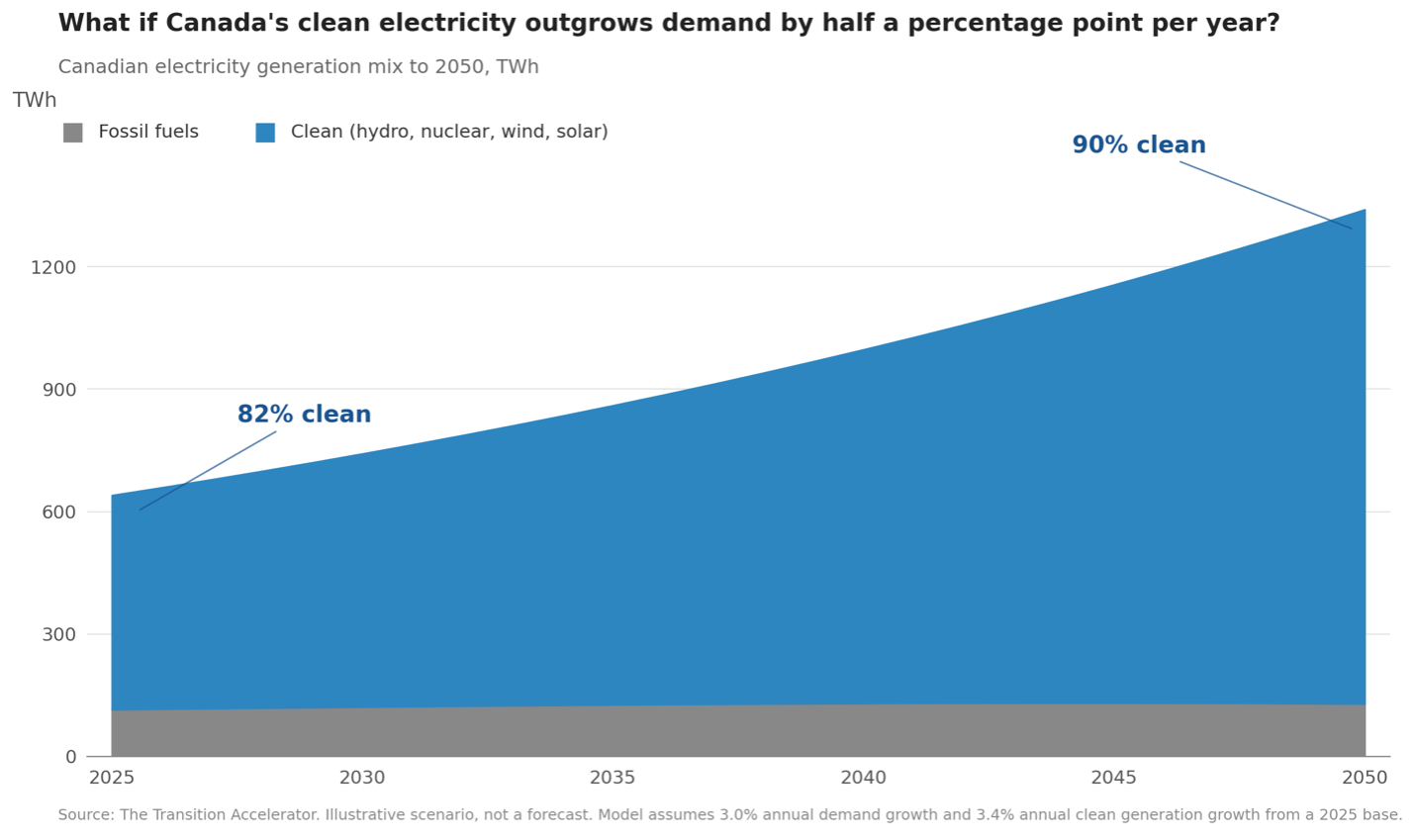
That scenario isn’t a forecast. It’s just one of several plausible paths, and the actual outcome depends on whether Canada sustains the pace of clean buildout the strategy is calling for. But it’s achievable. The Canada Energy Regulator has noted that between 2010 and 2023, renewable electricity generation in Canada grew several times faster than total generation. Clean energy has been outpacing overall grid growth for over a decade. The trajectory is already there.
So why not go further, all the way to 100% non-emitting? Because the cost of chasing the last few percentage points is well established. In the context of doubling electricity consumption to reduce emissions and drive economic growth, electricity must remain affordable. In a companion piece, Liebreich points to research from the US National Renewable Energy Laboratory (NREL) showing the marginal cost of decarbonizing electricity with proven technologies climbs from around $125 per tonne for most of the journey, and then rockets to $1,000 or more per tonne as you chase the last 10%.
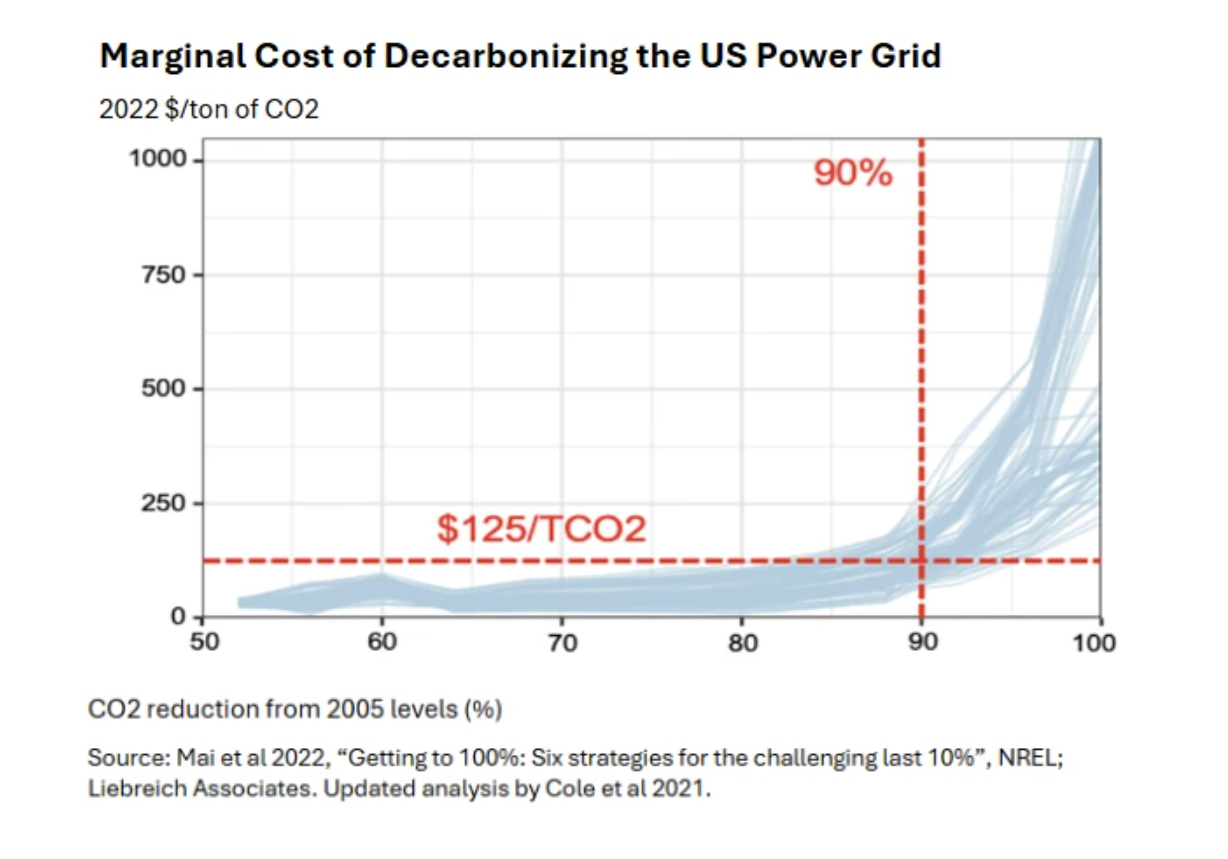
The same curve has been found to hold across jurisdictions. The point is straightforward: spending eight times more per tonne to chase the last remaining grid emissions pulls capital away from the bigger emissions reductions sitting in the rest of the economy. The Canada Electricity Advisory Council estimated that electrification and clean grids could deliver 268 Mt in emissions reductions across the economy by 2050. The electricity sector currently emits 47 Mt. The focus is clear.
Bruce Lourie made this case forcefully in the Globe and Mail last December, framing the choice as a paradox: the pursuit of a perfectly clean grid could end up stalling the broader electrification revolution Canada actually needs. As he put it, “Regulations are important to drive decarbonization, but flexibility is foremost if we are to double down on the main issue: rapidly accelerating the electrification of the economy.”
The last 10% will need to be addressed on the path to net zero, and technology advances are making it more feasible every day. But for now, Canada should focus its resources and regulatory constructs on the bigger prize that is achievable in the near term: a doubled, affordable grid that helps pull the rest of the economy off fossil fuels.
Here’s the irony. Describe this pathway to almost anyone — doubling the grid, reaching 90% clean, with a small gas wedge for reliability through the build-out — and they’d call it a win. The original CER would have ruled it out. The proposed CER amendments can be a correction to that mismatch, not a switch to gas. They can be what enables the rest of the economy to pivot to electricity.
What We Need to Get Right: Implementation
The document released yesterday articulates a vision and the strategic pillars to realize it. This is where the work starts, not where it finishes. The specific tactics are rightly left for consultation, because they need to be developed with provinces and territories, utilities, system operators, industry, labour, Indigenous Nations, and investors. As Electrifying Canada has demonstrated through its GridGuide tool and analysis, the barriers to electrification are rarely technical — and they can be eliminated by enhanced collaboration on implementation of these solutions.
A few things will matter more than others in the months ahead.
Doubling the grid isn’t an outcome the federal government can deliver alone. Provinces and territories hold jurisdiction. Utilities and system operators are the ones who actually plan, build, and operate the system. Industry and consumers generate the demand. Labour delivers the workforce. Indigenous Nations are partners and rights-holders. Getting these tables aligned, at pace, across regional differences, is the central implementation task — and it’s harder than the strategy document can fully capture.
Financing the build is the other big challenge. More than $1 trillion of investment over 25 years requires capital deployment at a scale Canada hasn’t attempted in generations. The strategy raises the question of ratepayer-versus-taxpayer balance and the role of federal financing tools, but it doesn’t settle the architecture. How costs are financed, recovered, and allocated across customer classes, jurisdictions, and generations will determine whether this is affordable for Canadians. Seven in ten households saving on energy bills is great, but the impacts on the other 30% still need to be managed. All that work is going to need real money in real budgets along with federal financing capacity that can stack with provincial tools. None of it can be deferred.
Each of the strategy’s pillars — supply chains, interties, regulatory reform, workforce, distribution, the North — has years of detailed design work ahead of it. The strategy has ensured that the pillars are now named and prioritized. The Transition Accelerator and Electrifying Canada look forward to supporting that work, catalysing implementation through government, utility and industry collaboration, which will draw on the analytical foundation we’ve built across electricity systems, industrial policy, and regional implementation.