Minister Joly’s trip to China has put two uncomfortable truths on the table. The first is that China now leads the world in autos, and Canada is playing catch-up. The second is that market liberalism — the faith that competitiveness will emerge on its own if government just steps aside — won’t cut it in a world dominated by industrial policy and geopolitics.
That second truth is the one Canada keeps refusing to absorb. A fashionable argument holds that if the auto sector can’t survive on its own, we should let it fade, as Australia did, and move our workers into industries where we hold some natural advantage. The logic is seductive, but wrong. It treats competitiveness as a fixed endowment the market reveals. But competitiveness is not found. It is built.
This is why Joly’s trip mattered. She went looking for partners, technology, and a path to learning — the three things a serious industrial strategy runs on. Each of the four companies she met carries a different model: BYD assembles abroad but keeps its supply chain in-house; Geely takes equity in Western firms; Chery pursues asset-light joint ventures and co-brands. Joly was right to reject the Stellantis–Leapmotor knock-down kit plan, because kits assemble cars without building capability. A joint venture that puts frontier technology and manufacturing processes on Canadian soil is worth pursuing.
The best bet sits in relationships that already exist. BYD has an EV joint venture with Toyota for a shared battery-electric platform, and Toyota assembles in Ontario today. A BYD–Toyota line in Canada would be one ideal outcome: EV manufacturing here, inside an incumbent we trust, with a partner who dominates the cost curve. Chery’s co-branding strategy, such as its collaboration with Jaguar Land Rover, offers another live option. Either model could achieve what Canada needs to rebuild competitiveness: selective exposure to the world’s best EV makers. Such exposure can discipline our producers and transfer know-how without surrendering majority ownership or user data. That is the play that built China’s own industry and Canada should run it.
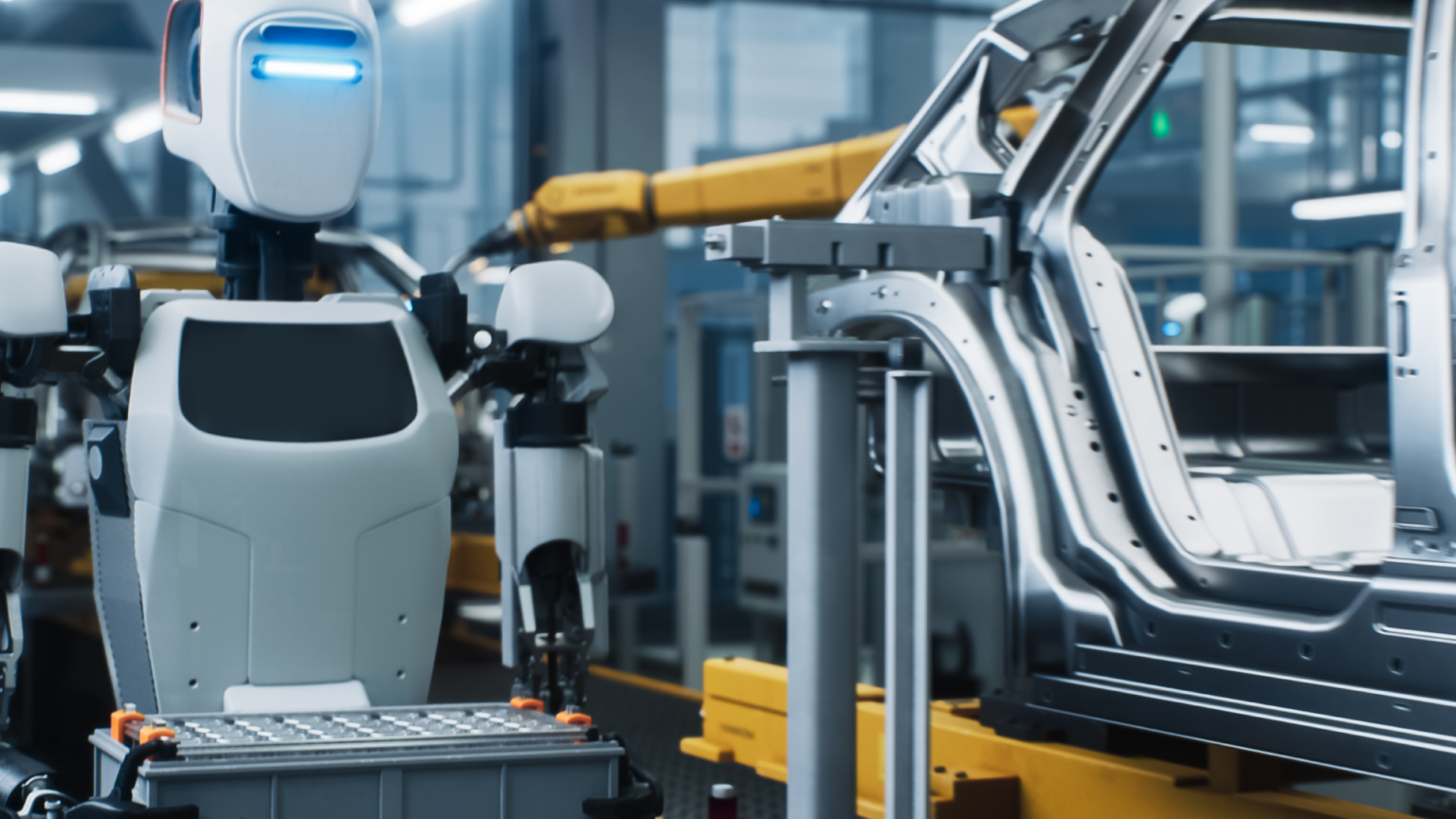
But a joint venture is only a beginning. The force that hollowed out Canadian assembly was labour costs, but physical AI is shifting this landscape. As humanoid robots and self-driving automation move onto the line, the labour-cost penalty that pushed production south will shrink. The country that masters robotic manufacturing first can seize comparative advantage. It is a once-in-a-generation chance to rebuild on a frontier where our high wages will stop being a 30-year liability.
We won’t find competitiveness or economic adjustment by accident. Capability at the frontier requires shared institutions, on the German Fraunhofer model, where firms learn faster together than any one of them could alone. Canada needs a robotics and advanced-manufacturing institute, stood up now, doing concrete things:
- Buy humanoids and test-drive them. Acquire Boston Dynamics’ Atlas-class machines, put them on real production lines to learn first-hand where they work best and what they cost to integrate.
- Compress the plant learning curve. A new or retooled line takes years to climb to competitive yield and throughput, and that ramp is where cost is won or lost. Digital twins and process-tuning models can slash the time it takes to get there. The institute should master that toolkit and spread it, so Canadian plants reach target cost in months rather than years.
- Build shared pilot infrastructure. Create standing, publicly staffed pilot lines where Canadian-owned suppliers can develop and prove automated processes on common assets. This builds collective, national know-how that is accessible to all firms. These pilot lines can draw on shared infrastructure to increase competitiveness and co-learn across the automotive, defence, and industrialized construction strategies.
This is the missing piece in the government’s new auto strategy. The architecture is right — emission standards, a remission framework that rewards investment in Canada, three billion dollars to help the sector adapt. But adapt toward what? The answer is the robotic frontier, and the institute is how money becomes the capability that links automotive, housing, and defence around the same machines and skills.
Letting the automotive sector fade is the counsel of a country that has decided its best days of making things are behind it. Joly came back from Beijing with partners, platforms, and the chance to learn from the firms now beating us. Turning those openings into capability is now the real work of Canadian industrial strategy: stand up the institutions, buy the robots, and secure the supply chain before the market “proves” any of it. That is how a country builds an advantage in a competitive world.