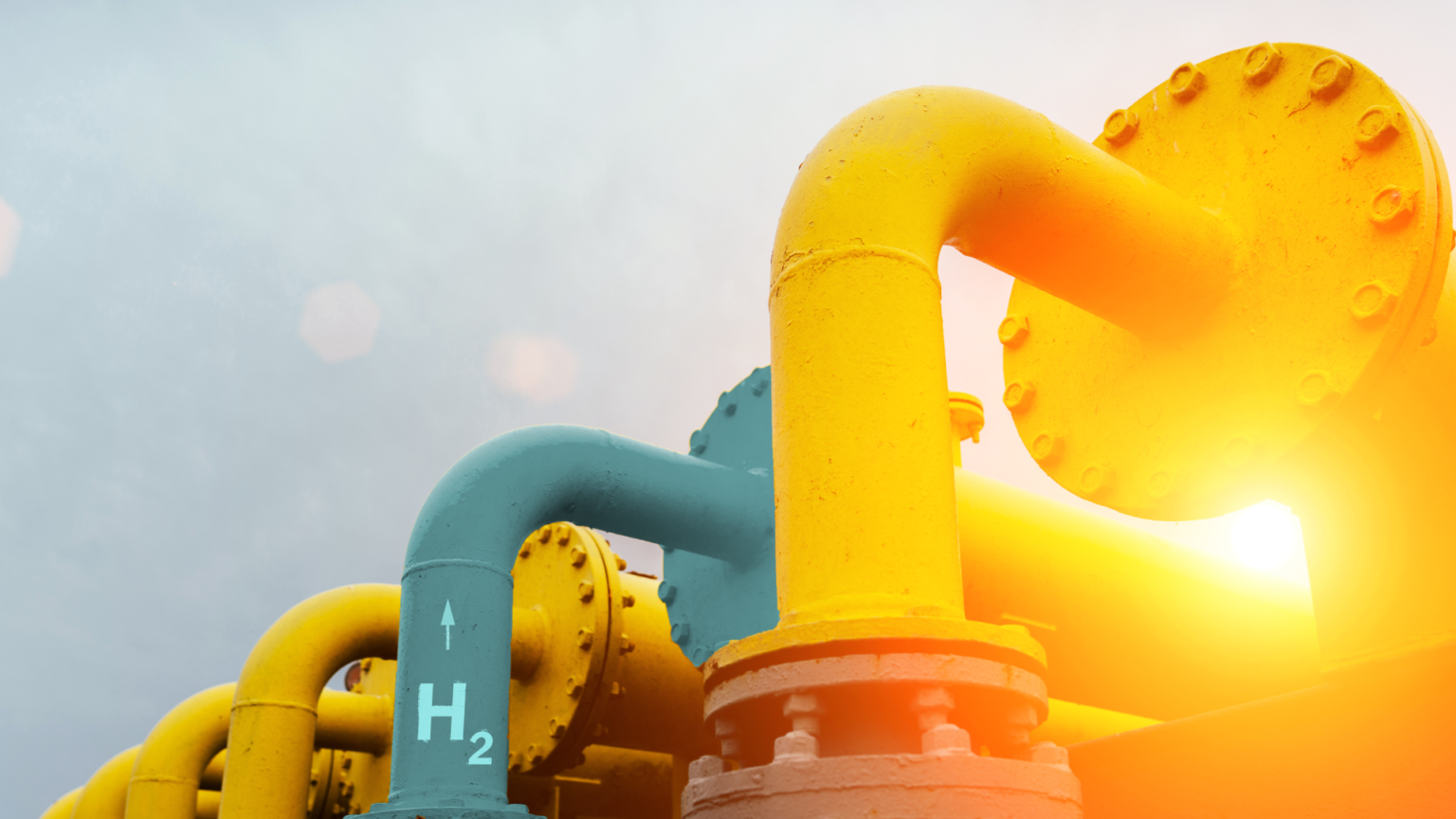
Blended Heat: Assessing Hydrogen Blending in Calgary District Heating System

August, 2026
By Zachary Cunningham, Zachary Redick, Amy Parenteau, Antoine Duplantie-Grenier

Calgary District Heating Inc. (CDHI) provides heat to buildings across downtown Calgary and the East Village using natural gas. This assessment looks at whether adding hydrogen to that system could help cut emissions. 

CDHI ran a successful test in 2023, mixing a small amount of hydrogen into its natural gas supply. It worked. This new assessment digs deeper: how would CDHI actually get enough hydrogen, and how much difference would it really make? 


Key Findings 

  • The 2023 pilot proved the concept, not the practice. CDHI successfully blended hydrogen into one boiler’s gas supply, but the test was short and only covered a narrow set of conditions. It shows the idea works, not that it’s ready for everyday use. 
  • Truck delivery is the only realistic near-term option. Building a pipeline or bringing hydrogen in by rail both face real challenges in a busy downtown setting. For now, delivering hydrogen by truck is what makes sense. 
  • A “20% blend” sounds bigger than it is. Hydrogen doesn’t carry as much energy as natural gas in the same volume, so a 20% hydrogen mix only replaces a small slice, well under 10%, of the actual energy used. Emissions savings shrink accordingly. 
  • Meaningful impact requires meaningful supply. To make a real dent in emissions, CDHI would need a steady supply of around 278 tonnes of hydrogen every year. 
  • How the hydrogen is made matters. If it’s produced using energy from fossil fuels, the overall emissions benefit shrinks further once the full picture is considered. 
  • The cost of cutting emissions this way is high compared to other options CDHI could pursue. 
  • The bigger opportunity may not be emissions at all. Hydrogen blending could help CDHI become an early customer for hydrogen in Calgary, helping build the local supply chain that other projects can lean on later. 

About the Author

Zachary Cunningham

Calgary Region Hydrogen Hub Lead

Zachary (Zak) Cunningham is the Calgary Region Hydrogen Hub Lead at the Transition Accelerator. He holds an MSc in Sustainable Energy Development from the University of Calgary, a B.Eng (Hons) in Petroleum Engineering, and a diploma in Petroleum Engineering Technology. Zak began his career in the oil and gas industry in the field, having spent extensive time on drilling and workover rigs in Western Canada and deepwater offshore in Malaysia in various roles, leading him to spend nearly a decade living overseas in Southeast Asia. Zak strongly connects with his Métis culture and the Métis community within Alberta and is particularly interested in sustainable energy development in remote Northern communities.

More

Zachary Redick

Analyst, Low-Carbon Fuels

Zachary is a transportation engineer with expertise in low-carbon systems and the net-zero transition. His work focuses on transportation systems analysis, QGIS-based spatial mapping, techno-economic modelling, and scenario development to support sustainable infrastructure planning. He has experience collaborating with industry associations, advising on net-zero policy, and presenting research at national conferences and webinars. His thesis on the net-zero transition of Alberta’s heavy-duty trucking sector was published in Transportation Research Part D, a leading journal in sustainable transportation.

He holds a Master of Science in Civil Engineering (Transportation) and a Bachelor of Science in Civil Engineering, both from the University of Calgary.

More

Amy Parenteau, P.Eng.

Director and Principle Consultant

Amy is a senior technical lead with over 20 years of experience in process engineering, process safety, and risk management within the energy sector. She uses rigorous scenario analysis to assess the safety and feasibility of complex energy projects. Throughout her career, Amy has leveraged her technical expertise to drive operational resilience, deliver margin enhancement, and align legacy asset designs with modern regulatory frameworks and industry safety standards.

More

Antoine Duplantie-Grenier, M.Eng.

Operations and Maintenance Analyst

Antoine works across several areas of the energy sector, including data and software engineering, techno-economic energy systems modelling, and the operation and maintenance of renewable assets. He holds a Master of Engineering in energy engineering from Polytechnique Montréal, along with a Bachelor of Engineering in electrical engineering. He has worked on energy transition problems at both ends of the scale, from national decarbonization scenarios and federal policy modelling down to the instrumentation and field data of individual wind, solar, and storage assets.

More